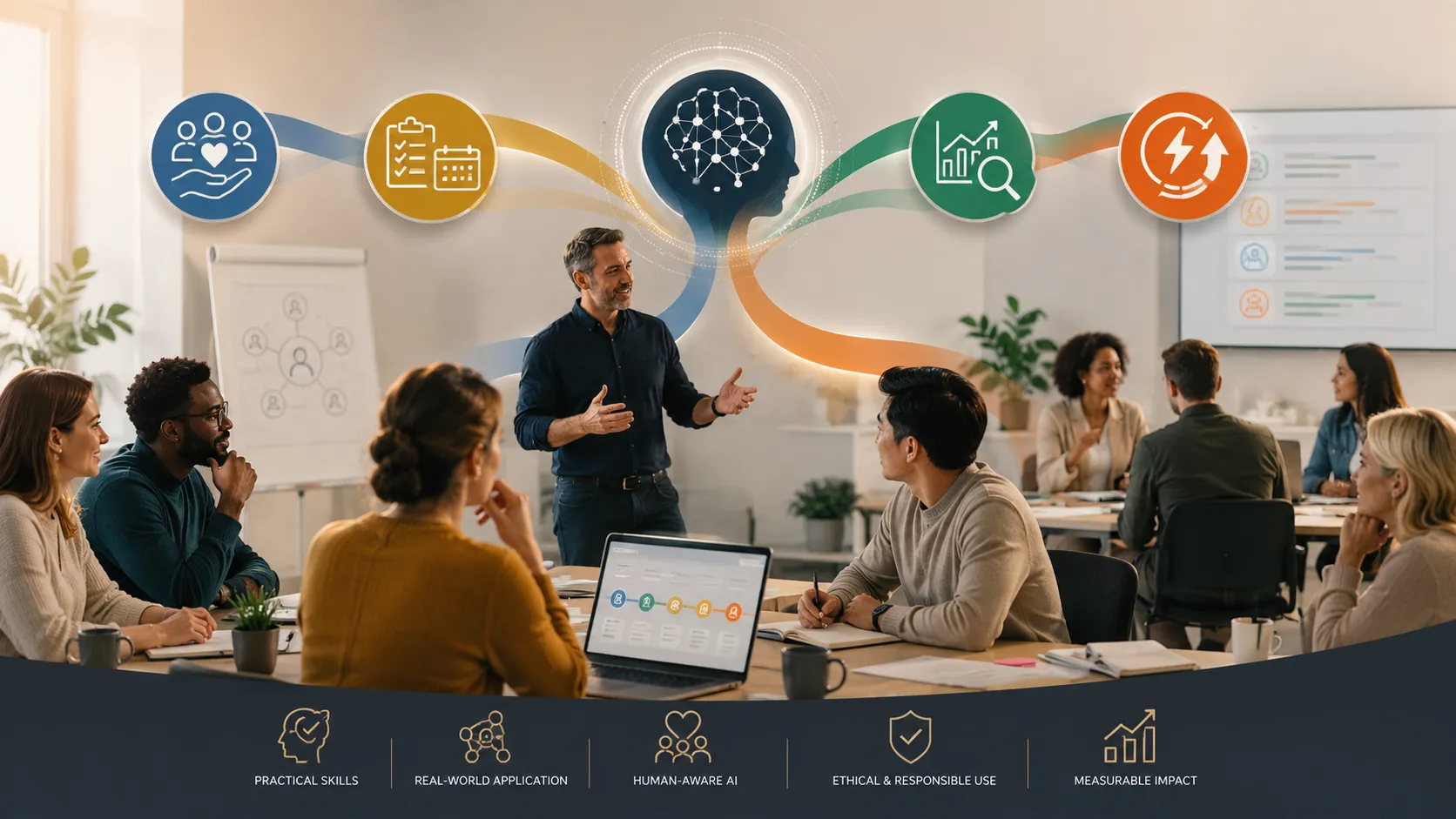
AI Workshops & Cohorts
Teach your team to use AI with judgment, confidence, and human awareness.
Practical AI workshops and cohorts for leaders, teams, consultants, and organizations that need real skill-building, not another surface-level tool demo.
Most people do not become useful AI users by watching someone else generate a clever answer on a screen. They need guided practice. They need examples from their own work. They need permission to ask basic questions and enough structure to avoid careless use.
My workshops help people learn how to use AI in a way that improves their writing, thinking, communication, training, workflow, and decision support while keeping human judgment in charge.
Tool demos fade quickly.
People remember that AI was impressive, but they do not know how to use it on Tuesday morning.
Teams lack shared standards.
One person uses AI carefully. Another pastes raw output. Another avoids it completely.
Examples feel too generic.
People need practice with their own emails, reports, lessons, proposals, workflows, and customer conversations.
Adoption is emotional as well as technical.
Some people are curious, some are skeptical, some feel threatened, and some need permission to start small.
Human purpose
Start with the reader, customer, learner, client, or team member the output must serve.
Clear process
Use repeatable steps, review habits, examples, and guardrails instead of random prompting.
Better judgment
Learn how to spot weak output, false confidence, bland language, and missing context.
Visible practice
Leave with prompts, drafts, workflows, and small wins participants can keep using.
Lab 1 Task framing
Participants learn how to define the job before prompting: audience, purpose, source material, constraints, tone, output format, and review standard.
Lab 2 Prompt patterns
Participants practice reusable prompt structures for drafting, summarizing, comparing, improving, explaining, planning, and preparing materials.
Lab 3 Output review
Participants learn to critique AI output for accuracy, missing context, blandness, weak reasoning, audience mismatch, and overconfident claims.
Lab 4 Human-aware revision
Participants revise output for different readers: people who need meaning, structure, logic, or action before they trust the message.
Leaders
Use AI to clarify strategy, prepare communication, review decisions, ask better questions, and lead adoption responsibly.
Marketing and sales
Use AI to improve positioning, landing pages, emails, audience-specific messaging, proposals, and objection handling.
Trainers and educators
Use AI to build lessons, activities, facilitator guides, participant materials, quizzes, and adaptive learning supports.
Consultants and creators
Use AI to turn expertise into frameworks, articles, resources, courses, prompts, client tools, and repeatable systems.
Operations teams
Use AI to document processes, create checklists, summarize information, draft internal guidance, and improve handoffs.
Client-facing teams
Use AI to prepare clearer explanations, follow-up notes, onboarding materials, service summaries, and support content.
Session rhythm
Each session introduces a skill, demonstrates it, gives participants time to practice, and ends with a work-related assignment.
Between-session practice
Participants apply AI to actual work and bring back questions, examples, successes, and problems.
Shared playbook
The cohort can build a practical internal guide with prompts, examples, standards, and recommended use cases.
Prompt patternsReusable structures for common tasks, not one-off clever prompts.
Output review checklistA practical way to judge accuracy, clarity, fit, tone, and usefulness.
Use-case mapA clearer picture of where AI belongs in the team’s actual work.
Role-specific examplesSample workflows, prompts, and outputs tied to participant responsibilities.
Human-aware revision habitsWays to adapt output for different readers, buyers, learners, and team members.
Next-step planA small set of practical actions for using AI after the workshop ends.
Good fit
✓You need your team to use AI more confidently and responsibly.
✓You want practical training tied to real tasks, not abstract theory.
✓You have leaders, consultants, creators, trainers, or staff who need shared habits and standards.
✓You want AI training that includes communication, temperament, human review, and applied judgment.
Not the best fit
×You only want a list of tools with no practice, standards, or workflow connection.
×You want people to use AI without human review or accountability.
×You expect one workshop to solve every technical, policy, security, and workflow issue.
×You do not want the training customized to real work, audience, or business context.
Can this be customized for our industry or team?
Yes. The strongest workshops use examples from the participants’ real work. The format, exercises, tools, and deliverables can be adjusted for leadership, sales, marketing, training, operations, client service, consultants, creators, or mixed teams.
Do participants need AI experience?
Not necessarily. The session can be designed for beginners, mixed-experience teams, or more advanced users. The key is to match the workshop to the actual participants.
Can you teach a remote workshop?
Yes. Workshops and cohorts can be delivered remotely, in person, or as a hybrid format depending on the group, schedule, and goals.
Will you cover specific tools?
Yes, when that is useful. But the training is not built around one tool. The deeper goal is to teach transferable habits: task framing, prompting, review, revision, workflow design, and human-aware communication.
Can participants bring real work?
Yes. That is usually best. Real tasks make the training more useful because participants can see how AI fits work they already understand.
What is the best first step?
Contact me with the audience, group size, goals, preferred format, and what you want participants to be able to do afterward. If the need is still unclear, an AI Strategy Session can help define the workshop.
Start here
Give your team AI skills they can actually use.
A good AI workshop should change what people do after they leave the room. We can build a briefing, workshop, lab, or cohort around your people, your work, and your goals.